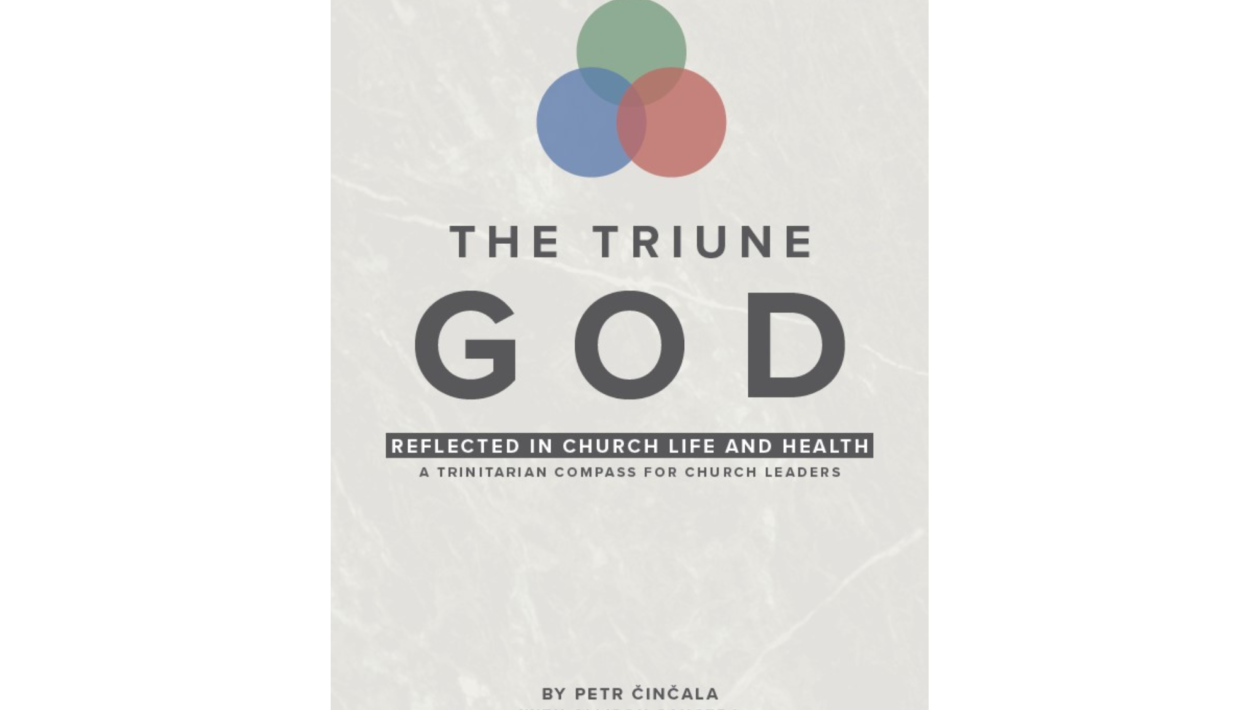
By Petr Činčala with Allison Sauceda
NCD America (2023)
Paperback, 93 pages
Reviewed by DAVID PENNO
How can a clear understanding and experience of the Triune God guide leaders as they seek to grow and develop healthy and healing Christian communities? Činčala and Sauceda’s answer is that leaders should emulate the way the Trinity leads as the develop their congregations in the eight characteristics of healthy, growing churches, as described by Christian Schwarz in Natural Church Development (NCD).
Petr Činčala is an associate professor of missiology and research at Andrews University and has been the executive director of NCD America since 2016. Allison Sauceda is a writer and assistant editor for the Journal of Applied Christian Leadership.
The Triune God focuses on leaders of local Christian congregations in a Western context and is written in a popular style, though academic sources are cited. It is short, concise, and easy to read. Yet it contains some very powerful ideas for Christian leaders.
The book is structured into two parts, with four chapters in the first and eight in the second. Part 1 focuses on defining and describing the Trinity, while Part 2 devotes a chapter to each of the eight NCD characteristics, indicating how a leader can emulate the Godhead in developing the congregation in that characteristic. The three colors of God (Schwarz, 2005) are used in each chapter to indicate how the Triune God shapes the development of the characteristic.
Due to limited space, I will share only about the chapter on empowering leadership. The key point of Chapter 5 is the distinction between empowered and empowering leaders. The goal is the latter. For the church to be healthy and healing, the pastor cannot do all the work of ministry. Instead, he or she must develop and deploy members as fully equipped and empowered leaders. Citing Schwarz, the authors describe the three essential characteristics of empowering leadership: “the ability to explain what is happening in/with the church and articulate where the church is going,” the ability “to motivate people to action,” and the capacity to liberate them to minister freely as God has equipped them (p. 28). Thus, the work of the leader is not to recruit volunteers but to develop and deploy empowered leaders. The model is the Trinity sharing leadership from the very beginning of creation.
The Triune God is well-written, easy to read and understand, and very practical. It is not an exhaustive study on the Trinity; rather it focuses on the practical ways to reflect the Godhead in leading the church to health and on mission. The book lacks gender inclusive language, using male pronouns when talking generically about pastors, and using only male pastors in the three scenarios about leadership (p. 27). But overall, the work is worth reading and is recommended for those leading in the local church context.
Reference
Schwarz, C. (2005). Color your world with Natural Church Development. ChurchSmart.
David Penno, PhD, is a professor emeritus of leadership at the Seventh-day Adventist Theological Seminary at Andrews University in Berrien Springs, MI.