
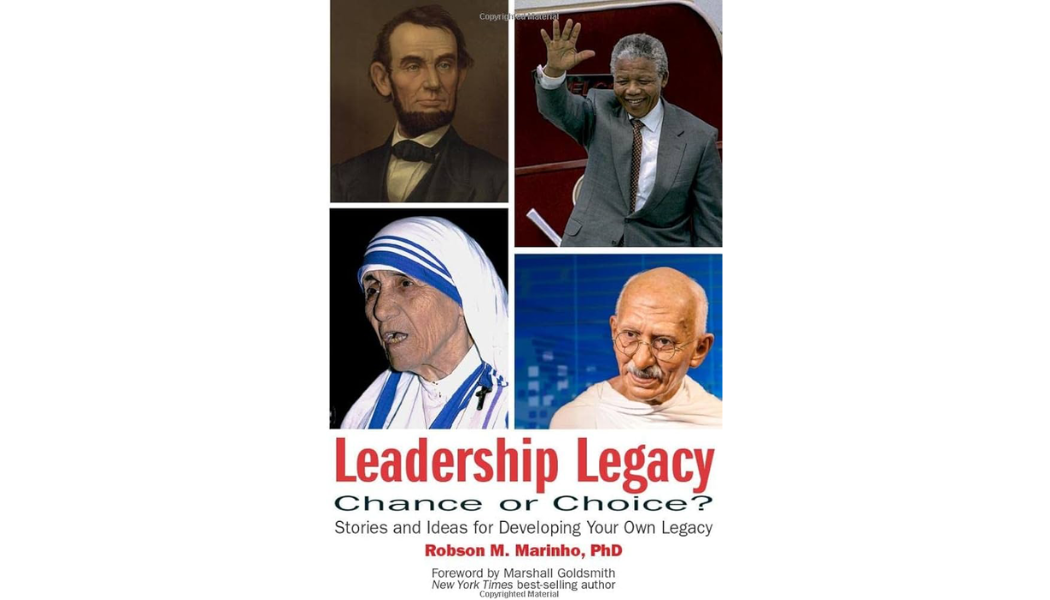
By Robson M. Marinho
Global Learning (2018)
Paperback, 367 pages
Reviewed by JAY L. BRAND
Introduction and Overview
If readers will allow a relevant metaphor, this book creatively employs a modified “bookends” structure, launching an intriguing blend of theory, analysis, biography, and narrative with leadership theories and the legacy of altruism, concluding with an inspiring description of the world’s most complete example of an altruistic, self-sacrificing servant-leader—Jesus Christ.
However, the book begins by inviting readers to reflect on the nature and impact of their own leadership legacy as they explore the rich content between those bookends. A review of political-structural perspectives on leadership and legacy from history frames that bookshelf of knowledge. This review includes a number of beliefs and truths about leading embraced to varying degrees throughout history, such as kingly sovereignty; Machiavellianism; influential, even charismatic tyrants; and other political and societal extremes. Thus, practical, working definitions of leadership originated as a consequence of monarchy, dictatorship, and other rigidly hierarchical socio-political structures, subsequently trending to include more strategic connotations as those socio-political contexts shifted toward more decentralized, even democratic, forms.
Relevant Theory and Scholarship
The book then turns to what will be familiar territory for any student of leaders and leadership, describing and evaluating the major categories of leadership theories—from trait, behavioral, situational, and contingency views— and elaborating on the enduring legacy of personality classification of leaders. Biographies of several leaders from modern history next serve to illustrate this emphasis on the historical assessment of personality, an example of the traits or intrinsic characteristics of leaders and leadership.
Yet within this familiar territory, the book offers a fresh, simple categorization for leadership theories. Some feature primarily a leader-focused evaluation, although others emphasize primarily the relational or social contexts and processes involved in leadership. I found this dichotomy intriguing because it points to the need for more examination of the interactive, emergent aspects of leading and leadership phenomena within groups, teams, communities, institutions, families, and organizations. Succinctly, leadership never occurs in isolation.
Historical Biographies
Enriched by this thorough theoretical framing, the book then describes many notable leaders from history, claiming for each of them an important, specific legacy: Abraham Lincoln—freedom; Mahatma Gandhi—independence; Eleanor Roosevelt—human rights; Martin Luther King, Jr. and Rosa Parks—civil rights; Mother Teresa— compassion and caring; Nelson Mandela—human dignity; Mikhail Gorbachev—perestroika; Paulo Freire—literacy; Muhammad Yunus—overcoming poverty; David Livingstone—humanitarianism; Jesus Christ—comprehensive,
self-sacrificing, servant leadership. I found the sequence of these biographies, ending with Jesus Christ, intriguing because it suggested that the noble triumphs of each leader reflected one or more facets of the complete, comprehensive illustration of leadership exemplified in the life and teachings of Jesus.
Along the way, the book crafts an absorbing comparison-and-contrast analysis of three American presidents, Abraham Lincoln, John F. Kennedy, and Barack Obama. Such analyses of contemporary leaders may invite subsequent critical evaluation given the increasingly divisive political conversation(s) occurring globally and the fact that historical examination has not yet forged a consensus. Nonetheless, the book’s innovative integration of history with leadership research and theory highlights its purpose: to encourage contemporary leaders to reflect on the nature, quality, impact, and endurance of the legacy of leading they are constructing, using each decision, conversation, attitude, behavior, directive, request, speech, and episode of influence over the people around them.
Reaction and Commentary
I felt the book maintained its fresh interpretation of both familiar and less well-known ideas about leadership throughout, without sacrificing theoretical accuracy, scholarship, or the rigor of its analysis and commentary. Imagining a more engaging approach to this subject matter would be difficult; I was captivated from beginning to end. I especially appreciated that the book included both recognizable and more obscure leaders from history—all clearly deserving of fame and accolades.
For the sake of objectivity and an attempt at balance, I might quibble that summarizing any of those transformational leaders with a single “legacy label” seems at least subjective and perhaps even problematic. Many of the terms used as labels are essentially synonymous (e.g., freedom and independence; human and civil rights and human dignity; useful change and overcoming poverty and illiteracy; compassion, care, humanitarianism, and altruism). Usually even one sour note may spoil an orchestra’s performance, but in this case, this observation is completely overwhelmed by the book’s original thesis on leaders and leadership— the salience of its legacy.
Jay L. Brand, PhD, is a professor of leadership and organizational studies, as well as the director of the leadership PhD program, in the School of Leadership at Andrews University.