By John F. Cosgrove Deeds (2023) Paperback, 250 pages
Reviewed by JAY L. BRAND & JOHN F. COSGROVE
Many leader advisors have become “household” names—people such as Steven Covey, Seth Godin, Simon Sinek, Teresa Amabile, Patrick Lencioni, Jim Collins, Vijay Govindarajan, Adam Grant, and Brene Braun. (Perhaps you would include several others.) All these gurus have one thing in common: they simplify the complexity and challenges of leadership to convey its essence. To some, this might seem to oversimplify reality; however, effective leadership maintains roots in something stable and trustworthy. This book explains how to accomplish that.
With this book, Cosgrove deserves to join that elite group of counselors. During a recent conversation, Cosgrove explained that a friend once encouraged him to read Victor Frankl’s classic, Man’s Search for Meaning. Cosgrove shared that he found it inspiring. Cosgrove’s book provides a practical, activities-based method for instilling very similar principles to those revealed by Frankl within leadership teams, organizations, and institutions. Using the familiar exercise of thinking about admired and despised leaders to determine what differentiates them, Cosgrove suggests that “self-less” and “self-serving” might label these two groups of leaders, respectively, in anyone’s experience.
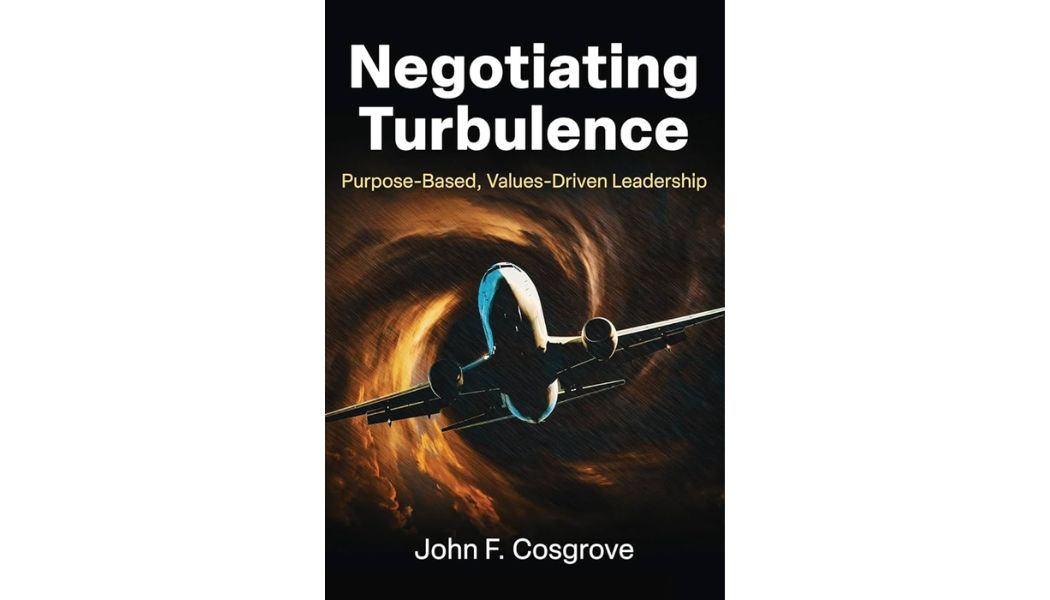
The title and cover of the book depict an important guiding metaphor: a pilot’s flight plan, which includes a destination, keeps the plane headed in the right direction, even in storms that threaten to blow the plane off course. Should wind or clouds drive the plane from its intended direction, the flight plan—particularly the destination—returns it to an accurate heading. In a similar way, one’s purpose (the most important among many possible goals) keeps leaders aware of their destination.
Life’s destination represents one’s purpose. To find their purpose, leaders need to improve self-awareness. In Section 1 of this book, Cosgrove describes how leaders (or anyone) can find their purpose through thoughtful self-reflection. Because organizational culture is a function of purpose and values, being aware of and articulating a unifying purpose and the values that frame decisions and behavior represents a crucial task for leaders to grow and maintain their culture.
Employing stories from his own experience throughout the book, Cosgrove provides compelling illustrations of the crucial importance of each piece of advice. Although purpose may define success and life’s destination, it cannot be pursued at any cost. Values frame the decisions and behavior used to follow one’s purpose. Alignment of purpose and values, across the company and throughout the workforce, can guide everyday practices and operations (e.g., hiring and firing, resource allocation, etc.).
Section 2 unpacks the metaphor of how a plane’s flight plan keeps it on course during a storm by adding the crucial role of the plane’s instruments. These instruments provide critical information to guide the pilot’s decisions and behavior. If one’s purpose represents successfully reaching the destination, these instruments correspond with one’s values. Such core values determine how leaders behave and how they make and implement decisions.
Again, by sharing stories, Cosgrove explores how one’s values ensure that one maintains focus on the right purpose. The only way to uncover one’s values is to pursue deep self-reflection: What do you believe in? What are your values? If you had only a short time to live, how would you spend your time? What are your personal priorities? How will your life contribute to the quality of others’ lives who live after you? Answers to these and similar questions reveal your values. Affirming and aligning value—between leaders and their organizations, throughout a leader’s core team members, and across various levels of a corporation—constitute essential tasks for leaders.
Section 3 explains how consistently pursuing one’s purpose and implementing one’s values can transform organizations and institutions; however, for leaders, this work must begin with transforming themselves by discovering, articulating, and adhering to their purpose and utilizing their core values. As in all five sections, this section, after framing many familiar values (e.g., transparency and learning organizations) in fresh ways, provides concluding remarks, action steps (e.g., answering these thoughtful and practical questions crafts a leader’s personal context for moving forward), and relevant scholarship for improving one’s transformational leadership potential.
Section 4 clarifies the often promising, yet commonly misunderstood, terrain of coaching and mentoring, explaining that coaching helps align effort with purpose and values, leading to consistent accomplishment. This section handles the problematic areas of difficult conversations and holding people accountable after providing them suitable coaching and mentoring experiences.
Section 5 rounds off the book, exploring how a clear and unifying purpose, along with articulated values, naturally motivates the heart in addition to inspiring the head. The consistency provided by a purpose and values shines fresh light on motivational theories (e.g., incentive gradients and Herzberg’s two-factor theory). Locke’s and Latham’s goal-setting theory would have fit here, yet its principles are addressed in other ways. As in the remainder of the book, the selection of scholarly references reflects wisdom and relevance rather than comprehensiveness.
Throughout this book, Cosgrove remains committed to the potential of leaders to change the world, one company or community at a time, if they will find and focus on their purpose and values. His experience, enthusiasm, and clear reasoning might convince even the most skeptical.
Jay L. Brand, PhD, is a professor of leadership and organizational studies, as well as the director of the leadership PhD program, in the School of Leadership at Andrews University.
John F. Cosgrove, PhD, is founder and CEO of The Leadership Workshop, LLC. He owns a financial firm and engages philanthropically through local nonprofits. A former director, senior VP, and president, Dr. Cosgrove has two daughters and six grandchildren.