
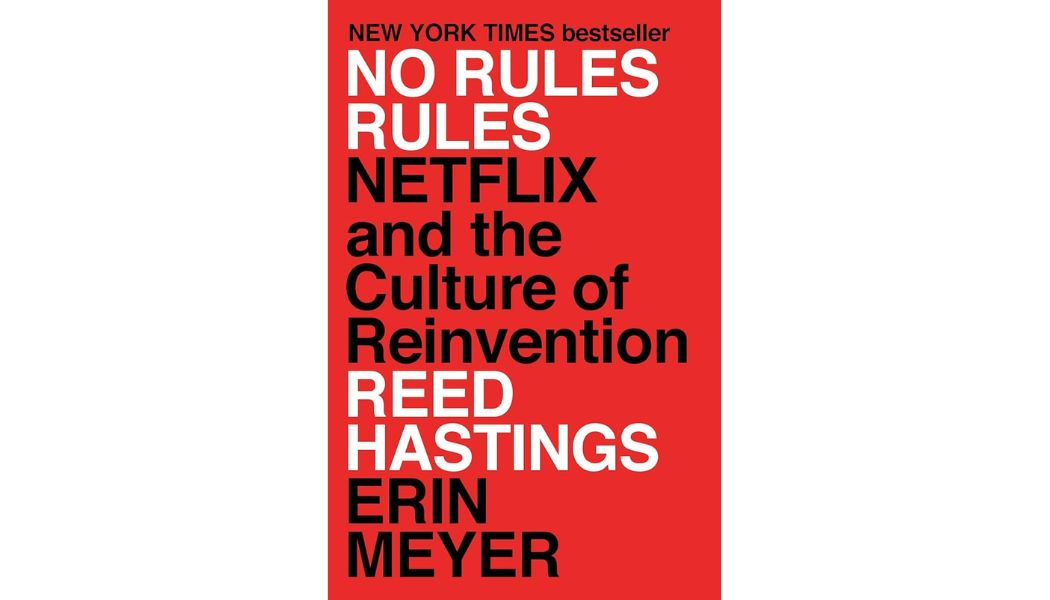
By Reed Hastings & Erin Meyer Penguin Press (2020) Hardcover, 320 pages
Reviewed by RAMIRO QUERO & JAY L. BRAND
Reading No Rules Rules would be a useful experience for entrepreneurs, leaders, innovators, and anyone interested in inspiring HR practices. Given Netflix’s growth and global presence, the book also appeals to its customers by outlining the company’s story and revealing the aspects of its work culture that have helped it grow and flourish.
The book’s structure features four sections, ten chapters, and one over-arching topic: encouraging a culture of freedom and responsibility. In the book’s first two sections, the authors outline six steps (one per chapter) to establish a culture of trust and accountability. Chapters seven through nine cover steps to reinforce this culture of freedom (e.g., trusting employees) and responsibility (e.g., individual accountability). The last section comprises the book’s final chapter, in which the authors propose how to scale their empowering HR model on a global scale.
The authors begin the book by outlining how Netflix has evolved during its relatively recent history as a company. The introduction’s first story describes how Blockbuster refused Netflix’s buyout offer. This refusal pivoted the leaders to restructure Netflix’s HR policies, launching them on the journey toward eventually becoming the much-admired firm we observe today. Because of its dual authorship, the book contains sections clearly written by each author. Hastings writes on the principles informing the policies underlying Netflix’s culture of freedom and responsibility, while Meyer presents her clarifying observations and analysis from interviews she conducted with leaders and employees at Netflix. Meyer also explains why the principles of the freedom ethos at Netflix work from a scholar’s perspective, presenting relevant research connecting trust with creativity and innovation.
Hastings draws from his experience at Netflix and Pure Software (his first company) to present the steps to create a culture of freedom and responsibility. In Chapter One, the authors posit that having stunning colleagues defines a great workplace. They highlight the principle of building talent density. To build an organization of high performers, you must provide generous severance packages to merely adequate performers. The resultant uniform improvement in the quality of the workforce will allow the elimination of most controls and restrictions, which in turn will foster greater freedom.
The second step to developing a culture of freedom and responsibility requires increasing the candor of communication. Thus, Netflix aims to reduce traditional polite protocols that can restrict honest interaction to establish a culture of feedback and accountability. Embedding feedback sessions within regular meetings represents one way to accomplish this; others include teaching employees how to properly give and solicit feedback, getting rid of “brilliant jerk” employees, and adequately modeling feedback solicitation and proper responses to feedback given to you as a leader. The authors share the “4-A” feedback guidelines here: aim to assist, actionable, appreciate, and accept or discard.
Reducing vague or unnecessary controls constitutes the third step to creating a free and responsible work culture. The authors describe two significant changes to reduce such controls in this chapter—removing any formal vacation policy and removing the requirement of travel and expense approvals. These strategies to shift corporate culture in innovative directions are not stand-alone steps that should be implemented ad hoc; instead, they are cumulative and sequential.
Section two of the book expands on establishing a desired culture of freedom and responsibility. In this section, the authors unpack the idea of fortifying “talent density”
by rewarding the company’s best “creatives” (i.e., creative employees) with financial incentives at or near the top of their labor tier, by not using performance-based bonuses, and by adjusting salaries to reflect changing markets. Further, the authors promote opening the typically confidential corporate books to increase candor, emphasizing organizational transparency to build trust. Wrapping up the book’s second section, in Chapter Six, the authors encourage leaders to release more of their traditional control—in particular, decision-making approvals. Taking smart risks should be encouraged, and more autonomy is invariably required. (“Don’t seek to please your boss” is a relevant phrase Hastings uses). The authors’ emphasis on farming for dissent, socializing ideas, testing out projects, and going for big bets reflects functional characteristics that speak to the signs (and requirements) of a culture of freedom and responsibility.
The book’s third section enlarges on techniques to reinforce a culture of freedom and responsibility after it has been established. In Chapter Seven, the authors present “The Keepers Test” to maximize talent density. In this regard, Netflix uses a professional sports team metaphor. High performance constitutes the core competency of the company. For example, rather than implementing PIPs, the authors recommend using such earmarked money to provide generous severance payments. Again, transparency regarding these decisions is emphasized to promote open dialogue and candidly answer staff questions. A general rule of thumb presented in the book combines speaking openly about work-related things with protecting individuals’ private lives by encouraging and answering questions to individuals directly.
In Chapter Eight, the authors promote creating feedback circles to maximize a culture of candor. As an example, this chapter offers the following practical advice: “Only say about people what you would say to their face.” Performance reviews are discouraged in favor of annual, written 360-degree feedback reports. Furthermore, numeric ratings and anonymity should be deemphasized in these reports. Such commitments to honesty and transparency continue to reflect the already-expressed operating philosophy. Leaders and managers are welcome to share the results of their 360 reports with those they lead. To facilitate this process of honest feedback, the authors recommend well-structured live “360-degree” dinners with small groups.
In Chapter Nine, Hastings and Meyer promote leading with context instead of leading with control by eliminating most unhelpful, useless controls. Leading with context can only occur and continue to thrive when the preceding steps have been successfully implemented. Leading with context encapsulates the litmus test for identifying an ideal culture of freedom and responsibility. To illustrate the advantages of this focus on context rather than control, the authors provide examples of other companies focused on innovation rather than error prevention. Yet they admit that perhaps not all businesses can or should create and nurture a culture of freedom and responsibility.
Lastly, the authors refer to Meyer’s The Culture Map to explain how corporate leaders might expand their business globally. This culture map consists of a mapping tool with eight culture scales (e.g., communication, decision-making, and trusting). Hastings and Meyer share their challenges encountered while taking Netflix global by using The Country Mapping Tool to adapt Netflix’s culture to align with the predominant culture of the country where they were expanding.
The authors explain that the model they present may not be relevant for all companies. In fact, Hastings explicitly insists that this culture-shift process primarily be tailored to highly innovative companies in a rapidly changing industry (i.e., entertainment). In this regard, my first reaction to the strategies outlined by Hastings and Meyer questioned how many of their recommendations might usefully transfer to other industries.
Nevertheless, I recommend No Rules Rules by Reed Hastings and Erin Meyer for their thought-provoking challenge to craft truly employee-focused companies. This book promotes healthy reflection for leaders who need to transform their culture toward more creativity and innovation, leading to a more prevalent growth mindset through-out their organizations. Nonetheless, many fields may not be conducive to creating a culture of freedom and responsibility. Even Netflix has pockets within its organization where rules and processes still reflect the status quo. Hastings closes the book with an accurate metaphor that reflects the core intent of their cultural philosophy, “A symphony isn’t what you’re going for. Leave the conductor and the sheet music behind. Build a jazz band itself.” There may be times and areas where the symphony model still constitutes the best approach, but to develop and nurture creative and innovative organizations and institutions, creating the conditions for jazz music remains essential.
Jay L. Brand, PhD, is a professor of leadership and organizational studies, as well as the director of the leadership PhD program, in the School of Leadership at Andrews University.
Ramiro A. Quero, MEd, is the program coordinator for the Global Leadership Institute and is working toward his PhD in leadership at Andrews University.