
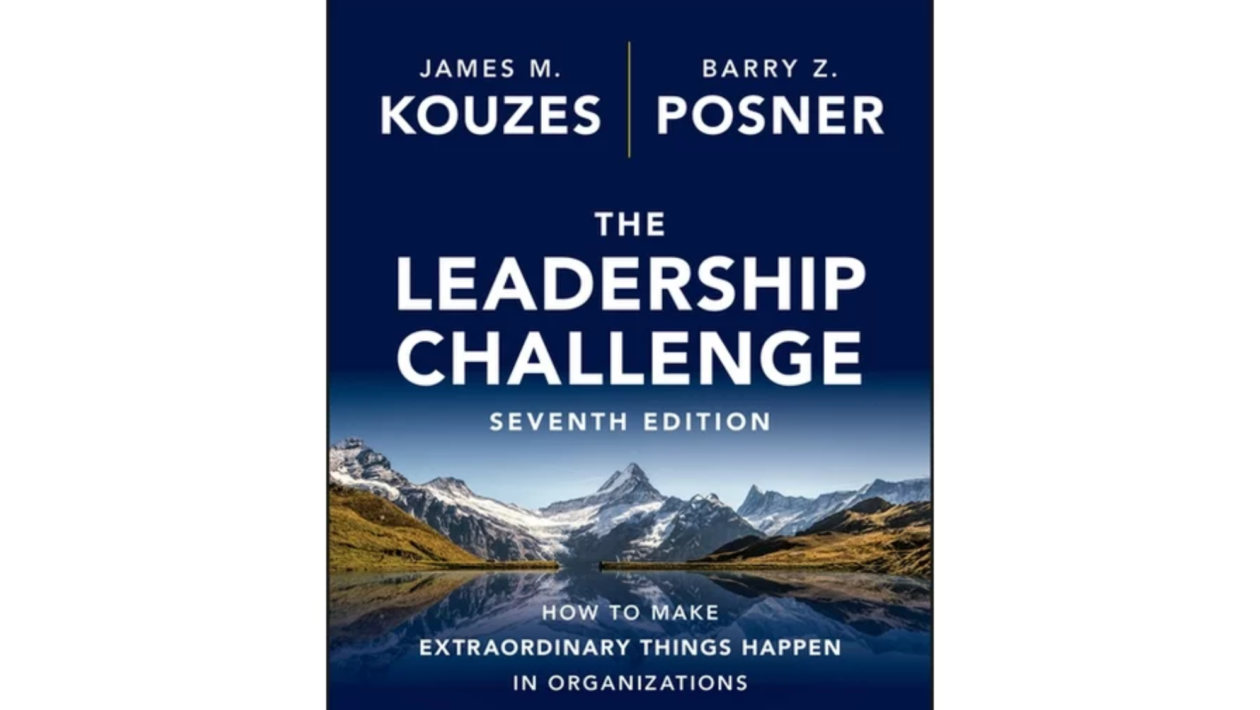
By James M. Kouzes & Barry Z. Posner
Jossey-Bass (2023)
Hardcover, 416 pages
Reviewed by SUNG KWON
The leadership curriculum of The Leadership Challenge builds on the best insights from a variety of fields, including the discipline of leadership itself. Over the past 30 years, leadership education has evolved as a field of study with theoretical frames, conceptual models, standards of practice, and diverse pedagogical strategies (Seashore Louis, Leithwood, Wahlstrom, & Anderson, 2010).
The body of academia on leadership theory continues to expand. In 2011 Peter Northouse published a student workbook, Introduction to Leadership: Concepts and Practice, to accompany his text written in 1997. James Kouzes and Barry Posner’s research led to their 1987 book The Leadership Challenge, and five exemplary practices provided a framework that captured the attention of leadership educators. Kouzes and Posner (2012) present five practices of a servant:
- Model the way: The ability to establish principles concerning how goals will be attained and the ways individuals interact, characterized by role-modeling good behavior, as well as setting expectations.
- Inspire a shared vision: The capacity to envision, passionately communicate, and enlist support for future possibilities for organizations and groups.
- Challenge the process: A willingness to examine and change the status quo, characterized by informed risk-taking and willingness to learn from mistakes.
- Enable others to act: The ability to engage others in shared processes characterized by mutual investment, collaboration, and empowerment.
- Encourage the heart: The capacity to recognize and celebrate accomplishments— both individual and group.
Additional research has linked these five exemplary leadership practices to perceptions of effective leadership, as well as demonstrating that students can increase the frequency of these skills through a variety of educational interventions (Dugan & Komives, 2011). This can serve as a powerful personal learning tool regarding one’s leadership behaviors and how others perceive them (Dugan & Komives, 2011).
However, Peter Northouse (2013) offers cautions about solely relying on the five practices. The model is designed as a starting point for leadership development and can be used to establish an important common language and help people expand their capacity to be engaged in leadership. When used in isolation, however, the model is largely perceived as leader-centric and lacks a complex consideration of context and capacities necessary for the group-versus individual-level interactions (Northouse, 2013). As the field of leadership education continues to evolve, both new and seasoned leadership professionals must lean on skills connected with lifelong learning as they continue to confront leadership topics that demand the application and integration of the latest knowledge.
One aspect complicating the understanding of the definition of leadership is the nature of the term itself. “The terms leader and leadership are often bandied about with little to no substantive explication” (Dugan & Komives, 2011, p. 35). Dennis Roberts (1981) described leadership as “a leader who knows self well; can analyze and diagnose environments; is able to be flexible and appropriately adapt to the situation; and who, in the end, has the foresight and imagination to see what the organization can be” (p. 212).
The term “leader development” is directed toward individuals to expand their capacity to be effective in leadership roles and processes, and the term “leadership development” is “the expansion of the organization’s capacity to enact the basic leadership tasks needed for collective work” (Van Velsor & McCauley, 2004, p. 18).
Leader development is directed toward cultivating the character traits of integrity, determination, transparency, passion, humility, and so forth in an individual. Leadership development is expanding a leader’s organizational and managerial ability to establish direction, motivate and inspire people, plan, solve problems, budget, organize, and so on. We must invest in both leader development and leadership development.
References
Dugan, J. P., & Komives, S. R. (2011). Leadership theories. In S. R. Komives, J. P. Dugan, J. E. Owen, C. Slack, & W. Wagner (Eds)., The handbook for student leadership development (2nd ed.). Jossey-Bass.
Kouzes, J., & Posner, B. (2012). The leadership challenge: How to make extraordinary things happen in organizations (5th ed.). Jossey-Bass.
Northouse, P. G. (2013). Leadership: Theory and practice (6th ed.). SAGE Publications.
Roberts, D. C. (1981). Student leadership programs in higher education. ACPA Media, Southern Illinois University Press.
Seashore Louis, K., Leithwood, K., Wahlstrom, K. L., & Anderson, S. E. (2010). Learning from leadership: Investigating the links to improved student learning. University of Minnesota.
Van Velsor, E., & McCauley, C. D. (2004). Introduction: Our view of leadership development. In C. D. McCauley & E. Van Velsor (Eds.), The Center for Creative Leadership handbook of leadership development (2nd ed.). Jossey-Bass.
Sung K. Kwon is an associate professor of leadership at Andrews University’s School of Leadership and is the director of the MA leadership in social innovation program.