

Abstract: It is known that emotional intelligence (EQ) is a skill that figures prominently in leadership and crisis management. According to D. Goleman’s perspective, EQ comprises five attributes that top leaders should exhibit to a high degree. In this study, we investigate Paul’s EQ in 2 Corinthians 11 using Goleman’s theory. 2 Corinthians is ideally suited to this purpose through its high emotional writing style. In this letter, Paul uses specific rhetoric to confront a group of false apostles who underestimated his apostolic authority. His arguments demonstrate that Paul was indeed a high-EQ leader. The lessons from Paul’s experiences are relevant to modern leadership crisis management theories as they provide empirical support to validate the importance of EQ for people in leadership roles.
Emotional intelligence (EQ) is a relatively new construct that is gaining increasing attention in leadership studies. Defined as the ability to recognize, comprehend and regulate one’s own and other’s emotions, EQ is essential to promoting self-awareness, effectiveness in interpersonal relationships, and personal resilience. Formally modeled by psychologists John D. Mayer and Peter Salovey in the early 1990s, EQ theory has since been developed further by Daniel Goleman, who divided EQ into five key components (Colman, 2001/2015). The first one, self-awareness, is defined as the ability to recognize one’s feelings, assets, limitations, and the values that shape one’s behavior. This capacity is considered the basis for the second component, self-regulation, which implies an ability to think before acting and to maintain one’s composure during stressful situations, such as crises. People with high levels of self-regulation can also demonstrate adaptability, trustworthiness, and ingenuity. The third component, motivation, is needed to move people closer to their goals. Motivation also drives enthusiasm, supports endurance, and cultivates resilient outlooks in times of adversity. These three components, which have an impact on how people handle themselves, are inward focused. By contrast, the remaining two components, which have an impact on how people interact with others, are outward-focused. Empathy is the capacity to perceive and relate to the emotions of others. It creates opportunities for interacting with a diverse range of people. Finally, social skills refer to one’s adeptness in establishing positive relationships with others. Those skills include efficient communication, dispute resolution, cooperation, and engagement (Goleman, 1998).
Goleman’s theory is widely accepted in the field of psychology for its contribution to contemporary leadership theories. However, the understanding that EQ is necessary for successful leadership is not a novel idea. On the contrary, historical sources from the ancient past refer to qualities among leaders that, in modern times, would be recognized as components of EQ (Colman, 2001/2015). For example, the writings of Plutarch (ca. 45–120 A.D.) on the virtues of leadership underscore the need for political leaders to communicate effectively and to understand the specific traits of their communities in order to lead them responsibly (Plutarch, ca.100/1936, Moralia, 799B–C; 800B–C; 808E–F). Furthermore, Plutarch urges leaders to surround themselves with moral partners, as he believes that a leader’s inner circle has a significant impact on their leadership. He also warns against the temptations of selfish pleasure that could be magnified in front of others as well as self-centered traits such as envy, discord, and malice, which detract from effective leadership (800D–F; 822C). Dio Chrysostom (ca. 40–120 A.D.), another prominent figure, emphasizes the importance of self-regulation in leadership. Dio believes that leaders must control their emotions to make wise decisions that benefit their followers (Dio Chrysostom, ca. 100/1932, On Kingship 1, 21). In reviewing Goleman’s theory, it is evident that several aspects of EQ can be found in Plutarch and Dio’s writings, who lived around the same period as Paul. In this paper, we will analyze how Paul in 2 Corinthians 11 applies the principles of EQ to his interactions with the Corinthians. Paul was a Christian leader in the churches he established. Given his role, we will next consider more closely the importance of EQ in leadership and crisis management.
The Importance of EQ in Leadership and Crisis Management
Emotional Intelligence is considered to be important for effective leadership because it enables leaders to: (a) handle their emotions; (b) foster strong relationships with others; (c) resolve conflicts; (d) adapt in the face of difficulties; (e) improve decision-making by considering the emotional consequences on individuals and teams; and (f) communicate efficiently (Goleman, 1996, 1998). High EQ-leaders are widely viewed as more capable of directing teams through crises than their counterparts. Specifically, leaders who master their emotional responses are considered to be role models for their teams. One reason is they can enhance the group’s ability to make tactical decisions during crises. Team members often feel fear, anxiety, and frustration in negative circumstances. High-EQ leaders can empathize with them and understand their worries. They are capable of engaging in compassionate communication and establishing realistic expectations by decreasing uncertainty (George, 2000). They are also more capable of making quick decisions in emergency situations, where swiftness of response is required. By executing rapid decisions while considering the emotional effects on team members, high EQ-leaders can create a cohesive environment. Lastly, by staying firm in the face of uncertainty, they exhibit adaptability, which builds trust and ensures the team that they are able to meet their team’s emotional needs (Goleman, 1998, George, 2000).
Not only is EQ important for managing team members but also for dealing with stakeholders, such as clients, partners, and the public (Côté & Miners, 2006; Goleman, 1998). During times of crises, leaders who are adept at managing the emotions of stakeholders are likely to be in a better position to build solid relationships and uphold trust (Côté & Miners, 2006; Goleman, 1998).
A Crisis in 2 Corinthians
The Apostle Paul was a tentmaker by trade and a leader in the church. He aspired to spread the Gospel in important cities of his time, such as Corinth, an ancient Greek metropolis that was rebuilt as a Roman colony in 44 B.C. Typical Roman urban features such as public buildings, temples, and a forum were on display. The city drew a varied population of Romans, Greeks, and Jews from all around the Mediterranean who were attracted by the business opportunities in Corinth. Because of this diversity, many temples had been built in the city and various other religious shrines had been erected. These were devoted to different gods and goddesses from a variety of religious traditions (Ehrman, 2004/2016).
During his second missionary voyage in Acts 18, Paul founded the Corinthian church (cf. Acts 15:36–18:22), which saw the writing of at least three epistles, including his letters to the Corinthians. The church was primarily Gentile but also included some Jewish Christians. Most scholars estimate that the Corinthian community might have consisted of 50 to 100 members who came from a variety of socioeconomic backgrounds, including middle-class tradespeople, wealthy clients, and lower-class individuals (Theissen, 2001).
His second epistle to the Corinthians can be divided into two sections. In chapters 1–9, Paul wants to reconcile with the community as his last visit was “painful” for both sides. Paul appears to have been harsh with the Corinthians on his previous visit because of their reckless actions in the church (2 Cor. 7:8–12). Now, he wants to mend the relationship. He also wants to request financial help for the poor Jewish community of Jerusalem (2 Cor. 8–9). In 2 Cor. 10–13, he defends his apostolic authority as a genuine apostle of Christ.
In these last chapters, Paul also refers to new leadership issues that were arising in the church (see 1 Cor. 1:13–24 for Paul’s handling of a previous problem). According to N. T. Wright (2018), these issues arose due to a clash between the principles of Christian living Paul was trying to inculcate and that of Roman culture. Roman officials in Rome and its provinces praised their accomplishments by inscribing them in stone or marble, akin to a resume. These inscriptions were known as the “course of honors,” and they detailed their roles from simple public official to an officer of broad authority with civic responsibilities and consulship duties. Attaining such authority was considered the peak of their political career, and serving as proconsul and conducting military campaigns were highly esteemed with soldiers fighting for the prestigious “mural crown.” The Corinthians’ admiration for these benefits reflected their interest in a culture of celebrities. Paul, however, did not adhere to this culture, and that was a serious problem for some Corinthians (Wright, 2018, pp. 313–314). Additionally, he did not possess physical talent, nor was he a skilled rhetorician in the manner of the Greeks and Romans. We can thus understand why a leadership problem occurred (Horner, 2018, pp. 31–32).
In 2 Cor. 10–13, Paul mentions a significant hurdle he was facing. The problem stemmed from a group of Christians who were disputing his role in the Corinthian community. Paul emotionally answers these charges, putting the well-being of Corinthian believers ahead of personal vindication (Carson & Moo, 1992/2005). Some scholars believe that these chapters belong to a different letter also written by Paul, and that these letters were later redacted by members of the Corinthian church (Ehrman, 2004/2016). However, according to F. Long, the rhetorical arrangement of the letter is evidence that 2 Corinthians is all of one piece (Long, 2004). If so, it follows that Paul is responding to a specific issue in this letter. It remains for us to analyze the nature of this response.
The Emotional Style of Paul in 2 Corinthians
Emotional Intelligence (EQ) has to do with emotions, and Paul’s emotions are apparent throughout the entire letter of 2 Corinthians. For instance, Paul states in 2 Cor. 2:4 (English Standard Version, 2001/2016): “For I wrote to you out of much affliction and anguish of heart and with many tears, not to cause you pain but to let you know the abundant love that I have for you.” The strong emotions that Paul felt when writing to the Corinthian community are reflected in this verse. Paul did not hesitate to use emotional language because he wanted to communicate his frustration to the Christians of Corinth (Witherington, 1995). Table 1 summarizes Paul’s emotions as they appear throughout his writing of 2 Corinthians.
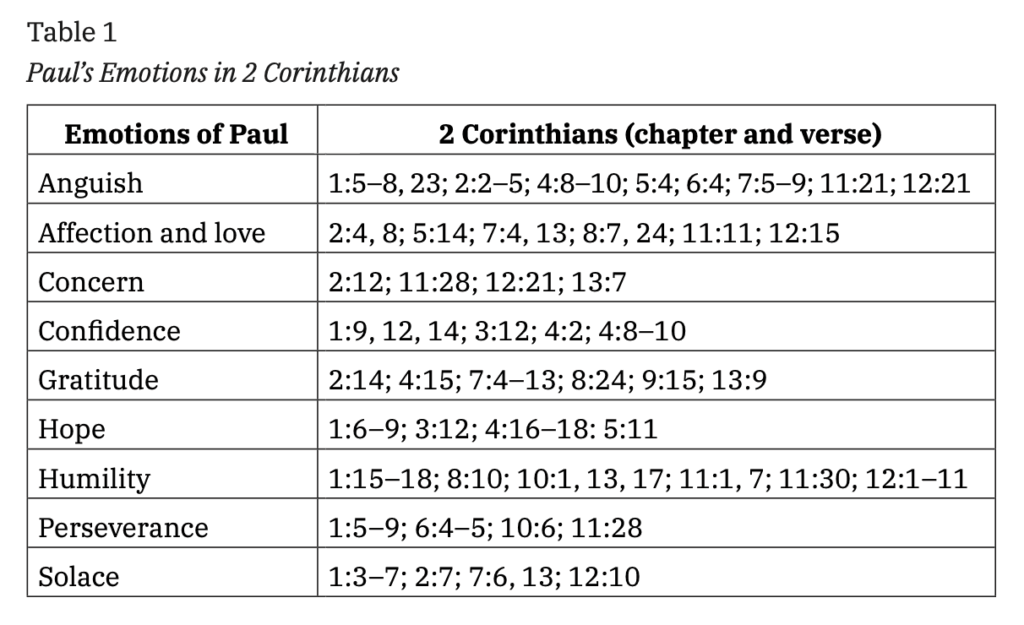
As Table 1 indicates, Paul held mixed feelings toward the church in Corinth. L. Welborn (2011) mentions that Paul’s writings can be analyzed using emotional theories of philosophers of the Hellenistic and Roman era. One such theory may be related to Aristotle’s (ca. 384–322 B.C.) notion of persuasion. According to Aristotle, persuasion is based on three factors: “The first depends upon the moral character of the speaker [ethos], the second upon putting the hearer into a certain frame of mind [pathos], the third upon the speech itself, in so far as it proves or seems to prove [logos].” (Aristotle, ca. 350 B.C./1926, Rhetoric, 1.2.3). It seems that Paul diverged from this formula when he was in Corinth. As a result, the extent to which this theory is useful for understanding 2 Corinthians is debatable (Winter, 1993). What Paul did was to develop a unique personal rhetorical style that incorporated elements of the Greco-Roman diatribe, a popular rhetorical form that enabled a speaker to express his emotions freely and eloquently. This departure from the norm may have been confusing to many of his readers and led them to initially question his leadership (2 Cor. 10:10). Paul spent a lot of time in Corinth (Acts 18:1–11) and had a close relationship with the Corinthian community, as shown in 1 and 2 Corinthians (Watson, 1993). This fact may explain the strong emotional elements that appear in 2 Corinthians.
Paul’s Arguments Against His Adversaries (2 Cor. 10–13)
According to Long, the structure of 2 Corinthians indicates that Paul wanted to respond to his opponents in a manner consistent with the common Greco-Roman rhetorical style familiar to his opponents; at the same time, he wanted to use his own unique diatribe-like style to develop his arguments, and the latter accounts for the variation in each chapter (Long, 2004). As we already mentioned, Paul’s opponents viewed him as a poor, unimpressive, and physically weak leader, both in relation to them and to the antiquated Great Man’s leadership model that the Caesars adopted at that time. However, Paul challenges their assumptions by stating that Christian leadership is opposed to this leadership model. This implies risk-taking and a willingness to suffer for the cause of the Gospel. Moreover, Paul claims in 2 Cor. 11:5 and 12:11 that he is not beneath those whom he refers to as “super-apostles.” This passage has generated considerable debate as to whether the author is alluding in an ironical way to the false apostles in the next verses, or if these super-apostles are Peter, James, and John, whom he describes as “pillars” in Gal. 2:9. The first interpretation derives from translating the Greek word ὑπερλίαν (hyperlian), which is extremely rare in classical works, as “super” or “extraordinary.” This term, however, can also be rendered as “over-great” or “eminent”, which would imply that Paul was speaking of the initial apostles with respect (2 Corinthians 11:5 Commentaries: For I Consider Myself Not in the Least Inferior to the Most Eminent Apostles, n.d.).
Paul appears to have several motivations in 2 Cor. 10–13. He addresses allegations of his faintness (10:1–11); contrasts himself with other, boastful apostles (10:12–11:33); recounts his supernatural experiences (12:1–10); reaffirms his apostolic authority (12:11–18); and offers guidance for the new challenges the Corinthians are facing (12:19–13:14). Alongside these motivations, he also counters critiques cast by some Corinthian members over his apostolic authority (10:2; 13:2, 10). Paul engages in what he calls “foolish boasting” (10:12–18; 11:16–28) to oppose their claims. By acting in this manner, he highlights the foolishness of exalting human accomplishments and instead encourages “boasting” in the Lord (10:17). Additionally, Paul’s sincere discussion of his “thorn in the flesh” (12:7) exposes an uncommon vulnerability in his letters. Through this openness, he wants to highlight that his strength is derived exclusively from Christ (12:10; 13:4); thus, it is not human (Keener, 2005). Those chapters also lay the groundwork for Paul’s forthcoming trip to Corinth (10:2; 12:20; 13:2, 10) and express his desire for the church to address its problems beforehand (10:6; 13:1–9) to avoid any stern measures upon his visit (Carson & Moo, 1992/2005).
Corinthians 11 and Goleman’s Theory
While Paul’s defense of his apostleship is the main topic of 2 Corinthians 11, there are many parallels between Paul’s attributes and Goleman’s model of EQ. In this section, we will examine how the attributes of Paul, presented in those verses, are strongly linked to Goleman’s theory.
Wright lists three ways that Paul’s accusers prompt Paul to respond to them: They reject the leadership style of Paul as non-glamourous; they discriminate within community; and they preach a different Gospel from Paul’s. Paul considers their third fault as the most severe (Wright, 2003/2004). In what could be considered an emotionally charged chapter, we can also dis-cern three key facts about Paul: He is intent to defend his apostleship (2 Cor. 11:1–6, 22–23); he wants to explain why he refused financial aid from the Corinthians (11:7–15); and he “boasts,” “foolishly,” as he says, in his suffer-ings (Wright, 2003/2004).
In 2 Cor. 11:1–6 Paul shows his concern for the Corinthians. He emotionally expresses his fear that they might be misguided by false teachings, just as Eve was deceived in the Garden of Eden (Gen. 3). He also states that he is not a prestigious rhetorician, although he was clear in his teaching to them in every way.
Next, in 2 Cor. 11:7–15 he contrasts himself with false apostles by reminding his readers that he did not receive financial aid to spread the Gospel. Instead, he shared the Gospel at no cost (cf. 1 Cor. 9:18). However, he is displeased that the Corinthian community questioned his love for them when, in fact, he accepted offers from other churches in order to help them. Thus, he now requests financial help from the Corinthians, but not for himself, but rather for the poor community in Jerusalem. The false apostles questioned his motives, leading the Corinthians to doubt him. They accused Paul of things he did not do, and that was the source of his problems. Consequently, Paul speaks of them in hard language, calling them servants of Satan, the Greek synonym διάβολος (diabolos) for Satan, meaning “accuser” (Wright, 2003/2004).
In 2 Cor. 11:16–33, Paul uses three examples to legitimize his true apostleship and reinforce his critique of these “false apostles.” First, he refers to his apparent weakness and contrasts it with the methods employed by those false teachers to legitimize their doctrines (11:16–21). Second, he refers to their boasting of their Jewish status as Israelites and descendants of Abraham (11:22–23). He responds by stating that he also shares these credentials but emphasizes that his sacrifices for the Gospel surpass every human asset (cf. Phil. 3:4–6). The third argument centers on Paul’s sufferings (11:24–33). As Paul takes care to emphasize, the false apostles have not suffered for the cause they presumably defend (cf. Acts 9:23–25; 14:19; 16:22–24).
It is thus apparent that Paul’s style of leadership as exemplified in 2 Corinthians 11 aligns with Goleman’s theory. As shown in Table 2, all five attributes that Goleman associates with high EQ are expressed in this chapter. Table 2 summarizes this information.
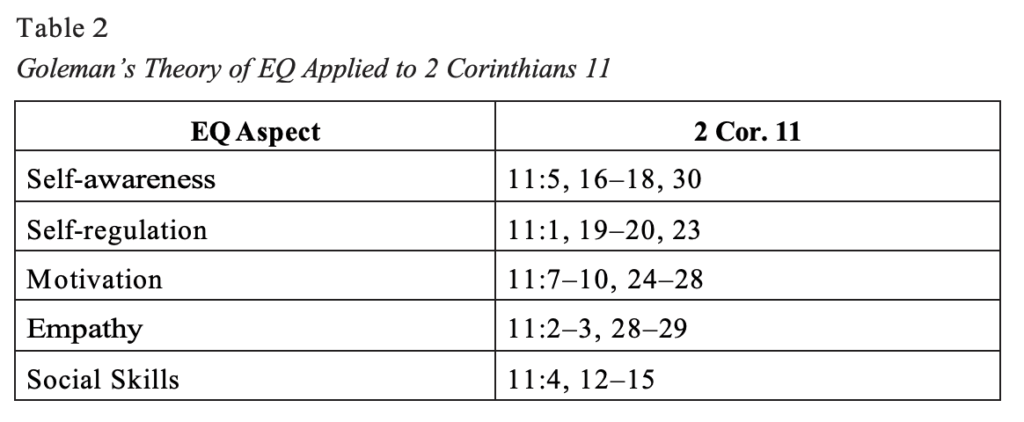
As Table 2 illustrates, 26 of the 33 verses in 2 Corinthians address aspects of leadership that a person with high EQ should, according to Goleman’s theory, possess. The following subsections address each of these aspects.
Self-awareness
When Paul calls his boasting “foolish” he reveals his self-awareness to the recipients of the letter: “I repeat, let no one think me foolish. But even if you do, accept me as a fool, so that I too may boast a little” (11:16). Paul knows that boasting and similar acts are incompatible with the new Christian ethics, which emphasize humility (11:17); however, his accusers appear to have been bragging about their noble deeds. Therefore, he emulates them in an ironic way, boasting about achievements that are quite opposite to those that were highly regarded in the Greco-Roman period. As he states, “Since many boast according to the flesh, I too will boast” (11:18). His use of the word “foolish” to describe his own bragging, which he knows can be annoying to his brothers and sisters (“accept me as a fool”), indicates that his “boasting” is somewhat facetious. Paul is well aware that he is not a leader in the way of his opponents, but he wants to encourage the Corinthian believers to adopt attitudes that match the virtues exemplified by Christ and to avoid leaders who boast of their own skills. Thus, he concludes: “If I must boast, I will boast of the things that show my weakness” (11:30). Finally, assuming that Paul is speaking of the original apostles in 2 Corinthians 11:5, it is apparent that he recognizes not only the irony of his words but also his place both among the apostles and the Church community.
Self-regulation
Paul asks Corinthians to overlook his “foolishness,” saying, “I wish you would bear with me in a little foolishness. Do bear with me!” (2 Cor. 11:1). Moreover, he avoids angry speech when criticizing: “For you gladly bear with fools, being wise yourselves! For you bear it if someone makes slaves of you, or devours you, or takes advantage of you, or puts on airs, or strikes you in the face” (11:19–20). Finally, he highlights his struggles to show again that true apostolic leadership is characterized by devotion to Christ: “Are they servants of Christ? I am a better one—I am talking like a madman—with far greater labors, far more imprisonments, with countless beatings, and often near death” (11:23). Through this passage, Paul wants to convey the truth of the Gospel without becoming aggressive; thus, he chooses to speak in an embarrassing manner about himself. By humbling himself, he also shields himself from accusations of egotism or autarchy.
Motivation
Love language is strongly apparent in Paul’s early letters (e.g., Rom. 13:8–10; 1 Cor. 13; Gal. 5:14; Phil. 1:9; Philem. 1:9). Paul’s motivation stems from his love for Christ (2 Cor. 5:14–15). In 2 Corinthians 11:24–27, Paul recounts his many adversities, which included persecution, physical suffering, shipwrecks, dangers from various sources, hunger, thirst, and continuous hardship. By doing so, he shows to the Corinthian community that he is willing to go through great pain to accomplish his goal. His love for them is sacrificial. Paul is focused on serving the church, and he shows again to his adversaries that true Christian leadership motives should be selfless: “And, apart from other things, there is the daily pressure on me of my anxiety for all the churches” (11:28). Paul’s purpose is to highlight genuine Christian leadership, which is characterized by service to others and sacrifices that do not lead to personal gain (11:7) but are often made at significant personal expense.
Empathy
In 2 Corinthians 11:3, Paul worries that the new Christians may be deceived: “I am afraid that as the serpent deceived Eve by his cunning, your thoughts will be led astray from a sincere and pure devotion to Christ.” He thus expresses a “divine jealousy” for their situation (11:2). In 11:28, alongside the aspect of motivation previously mentioned, we also observe the aspect of empathy. Specifically, by using the word “anxiety,” Paul expresses his deep concern for the needs of all the churches he had established. Moreover, in 11:29, he poses the following rhetorical question: “Who is weak, and I am not weak? Who is made to fall, and I am not indignant?” This verse shows that he can perceive the feelings of the Corinthians during a challenging situation. Paul engages spiritually with the challenges of his brothers and sisters. He also expresses his compassion for them. Furthermore, he emphasizes the importance of steadfast faith and the dangers associated with deviating from the teachings of the Gospel. Finally, he shows that he cares for the Corinthians in practical ways by sending his disciples to them when he cannot attend in person (see 2 Cor. 7:5–7).
Social Skills
Paul has exceptional social skills as shown in his strategic use of language. Throughout these verses, Paul uses rhetorical questions and irony (Witherington, 1995) to present his point of view (11:6, 21–22), challenge false apostles (11:13–15), and chastise the Corinthians for accepting teaching from false leaders (11:4). In 2 Corinthians 11:13–15, Paul speaks in harsh terms about these so-called “leaders” whom he compares to Satan and his deceitful actions (cf. 1 Cor. 5:5). Also, he warns that despite these false apostles posing as servants of Christ, their true intentions will be exposed by their actions, leading to their downfall. In 11:4, Paul writes that his contention with these adversaries stems both from their rejection of the Gospel and their alteration of its message (Witherington, 1995). Paul is concerned that they are leading people astray; however, he does not attack his adversaries directly (11:6, 21–22). Instead, he exposes them cleverly (11:13–15). His mastery of communication building is demonstrated by his ability to engage his audience and handle complex situations.
Overall, Paul’s communication strategies in 2 Corinthians 11 reveal that he has high EQ in all five aspects that are central to Goleman’s theory of leadership. His language reveals that he is self-aware, highly motivated yet capable of regulating his emotions and speech, empathetic, and socially competent.
The Results of the Corinthian Crisis
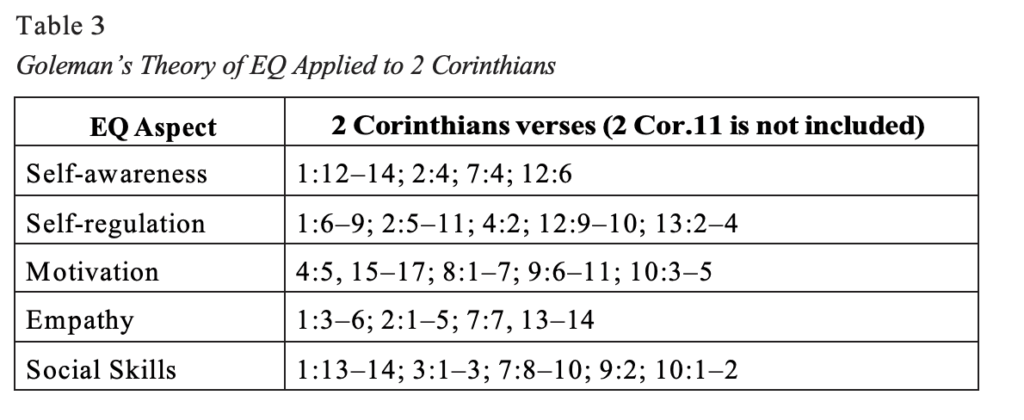
Direct evidence is scarce concerning how the issues mentioned in 2 Corinthians were resolved. Moreover, the lack of further communication from Paul to the Corinthians leaves open questions. However, several hints in the text suggest that the leadership problem was resolved positively. First, shortly after sending his second letter to the Corinthians, Paul received a warm welcome from a notable Corinthian, Gaius. It was from Gaius’s house that Paul probably wrote the letter to Romans (Rom. 16:23). Second, when leaving Corinth, Paul had to change his travel plans because a plot was being devised against him from the side of fanatic Jews who wanted to kill him. Paul evaded this trap (Acts 20:3), but the fact that his life was in danger indicates that his message was heard. Third, in 2 Timothy, which is probably the last letter of Paul, the mention of Erastus, a prominent figure in the Corinthian church, suggests that the relations between Paul and the Corinthians were still sustainable (2 Tim 4:20; cf. Acts 19:22; Rom. 16:23). Fourth, a letter from Clement, bishop of Rome, to the Corinthians, written around 40 years after Paul’s letters, shows that the Corinthian church still existed and was facing new challenges (Clement, ca. 100/1896, Letter to the Corinthians, 47). Finally, the shift within Greece from polytheism to Christianity that took place during Paul’s time is closely connected to Paul’s leadership over early Christian communities. Thus, despite the lack of direct proof that Paul was able to resolve the Corinthian leadership issue, the evidence suggests that he was successful, at least to a certain extent. Table 3 shows how his EQ helped him. From this table, it is apparent that at least one EQ aspect of Goleman’s theory is present in practically every chapter of 2 Corinthians.
What Can Today’s Leaders Learn from Paul’s Experience in Corinth?
Paul’s experience with crisis management within the Corinthian community offers valuable lessons for contemporary ministry and church leaders. Regarding Goleman’s EQ theory, several key points emerge. First, Paul was aware of both his strengths and weaknesses, and he was familiar with the context of the Corinthian community. In the same way, contemporary leaders should “examine” themselves every day (cf. 2 Cor. 13:5; Gal. 6:4), learn the problems of their community, and help their people in the ways they are able. Second, although Paul frequently uses emotional language in 2 Corinthians, he also exhibits self-regulation while handling the leadership issue in the Corinthian church. Self-regulation has been considered a virtue for leaders since ancient times. Similarly, modern leaders should cultivate this aspect, as it can be proven helpful for their community during difficult times. Third, Paul prioritized the common good of the community over his personal interests. Paul was not a self-centered leader, and thus he set an example for modern leaders to follow. Like him, modern leaders should behave in a way that inspires their people with altruistic principles (cf. 1 Cor. 10:33). Fourth, Paul’s concern for the Corinthians demonstrates a high level of empathy. Similarly, contemporary leaders must be attentive to their team members’ challenges. That will help them to build rapport with their community, especially during a crisis. Finally, one of Paul’s strengths was effective communication. For example, in 2 Corinthians 11, Paul used the appropriate rhetorical devices for the occasion, as previously discussed. Paul’s deeper understanding of the community informed his choice of language, allowing him to speak in a way that resonated with his audience. His paradigm teaches us that communication skills are important for modern leaders to master.
Conclusion
In 2 Corinthians 11, Paul exhibits the characteristics of a high-EQ leader. Specifically, he demonstrates self-awareness and self-regulation, engaging in mock boasting to undermine false apostles who wanted to mislead the Corinthian community for their selfish reasons. In addition, his deep empathy is shown in his concern for the Corinthians’ vulnerability to these false teachings. Furthermore, through his openness about his own struggles, his motivation for writing the letter becomes clear: Paul wants to express to the community that genuine Christian leadership operates in an opposite way to the Greco-Roman model. Lastly, he presents his arguments to the Corinthian faithful with a high level of rhetorical skill that indicates he is also speaking to his accusers, yet without being provocative. Stated otherwise, Paul is socially astute. While explicit sources confirming Paul’s effective resolution of the leadership crisis in Corinth do not exist, an abundance of indirect evidence suggests this possibility.
Paul’s example can be beneficial in the contemporary global ministerial context. Twenty-first-century ministry and church leaders can learn from Paul’s high EQ in dealing with crises, as seen in 2 Corinthians. By emulating his approaches, they can focus on cultivating key aspects of EQ.
Sotirios S. Despotis, PhD, is a professor and head of the Department of Social Theology and the Study of Religion at the National and Kapodistrian University of Athens.
Loukas M. Domestichos, M.Th. in Biblical Studies, is a PhD student in the Department of Social Theology and the Study of Religion at the National and Kapodistrian University of Athens.
References
Aristotle. (1926). The art of rhetoric (J. H. Freese, Trans.). Loeb Classical Library (vol. 193). Harvard University Press and William Heinemann Ltd. (Original work published ca. 350 B.C.)
Carson, D. A., & Moo, D. J. (2005). An introduction to the New Testament (2nd ed.). Zondervan.
Clement. (1896). Letter to the Corinthians. In A. Menzies (Ed.), Ante-Nicene Fathers (Vol. 9, J. Keith, Trans.). Christian Literature Publishing Co. (Original work published ca. 100).
Colman, A. M. (2015). Emotional intelligence. In A dictionary of psychology (4th ed., pp. 244–245). Oxford University Press.
2 Corinthians 11:5 Commentaries: For I consider myself not in the least inferior to the most eminent apostles. (n.d.). Biblehub.com. https://biblehub.com/commentaries/ 2_corinthians/11-5.htm.
Côté, S. & Miners, C. T. H. (2006). Emotional intelligence, cognitive intelligence, and job performance. Administrative Science Quarterly, 51(1), 1–28. https://doi. org/10.2189/asqu.51.1.1.
Dio Chrysostom. (1932). Discourses 1–11 (J. W. Cohoon, Trans.). Loeb Classical Library (Vol. 257). Harvard University Press. (Original work published ca. 100).
Ehrman, B. (2016). A brief introduction to the New Testament (4th ed.). Oxford University Press.
English Standard Version Bible. (2016). BibleGateway.com. Retrieved from https://www.biblegateway.com/versions/English-Standard-Version-ESV-Bible/
George, J. M. (2000). Emotions and leadership: The role of emotional intelligence. Human Relations, 53(8), 1027–1055. https://doi. org/10.1177/0018726700538001.
Goleman, D. (1996). Emotional intelligence: Why it can matter more than IQ. Bloomsbury.
Goleman, D. (1998). Working with emotional intelligence. Bantam Books.
Horner, J. M. (2018, July 1). Leading like a fool: An evaluation of Paul’s foolishness in 2 Corinthians 11:16–12:13. Perichoresis, 16(3), 29–43. https://doi.org/10.2478/ perc-2018-0015.
Keener, C. (2005). 1–2 Corinthians. Cambridge University Press.
Long, F. J. (2004). The rhetorical disposition of 2 Corinthians. In Ancient rhetoric and Paul’s apology: The compositional unity of 2 Corinthians (pp. 143–198). Cambridge University Press.
Plutarch. (1936). Moralia, volume X: Love stories. That a philosopher ought to converse especially with men in power. To an uneducated ruler. Whether an old man should engage in public affairs. Precepts of statecraft. On monarchy, democracy, and oligarchy. That we ought not to borrow. Lives of the ten orators. Summary of a comparison between Aristophanes and Menander (H. N. Fowler, Trans.). Loeb Classical Library (Vol. 321). Harvard University Press. (Original work published ca.100).
Theissen, G. (2001). The social structure of Pauline communities. JSNT, 84, 65–84. Watson, D. F. (1993). Diatribe. In G. F. Hawthorne, R. P. Martin, & D. G. Reid (Eds.), Dictionary of Paul and his letters (pp. 178–179). InterVarsity Press.
Welborn, L. L. (2011). Paul and pain: Paul’s emotional therapy in 2 Corinthians 1:1–2, 13; 7:5–16 in the context of ancient psychagogic literature. New Testament Studies, 57(4), 547–570. doi:10.1017/S0028688511000142.
Winter, B. W. (1993). Rhetoric. In G. F. Hawthorne, R. P. Martin, & D. G. Reid (Eds.), Dictionary of Paul and his letters (pp. 586–587). InterVarsity Press.
Witherington III, B. (1995). Conflict and community in Corinth: A socio-rhetorical commentary on 1 and 2 Corinthians. Eerdmans.
Wright, N. T. (2004). Paul for everyone: 2 Corinthians (2nd ed.). Westminster John Knox Press.
Wright, N. T. (2018). Paul: A biography. HarperCollins. https://www.amazon.com/dp/B072L5DTCH/ref=docs-os-doi_0